

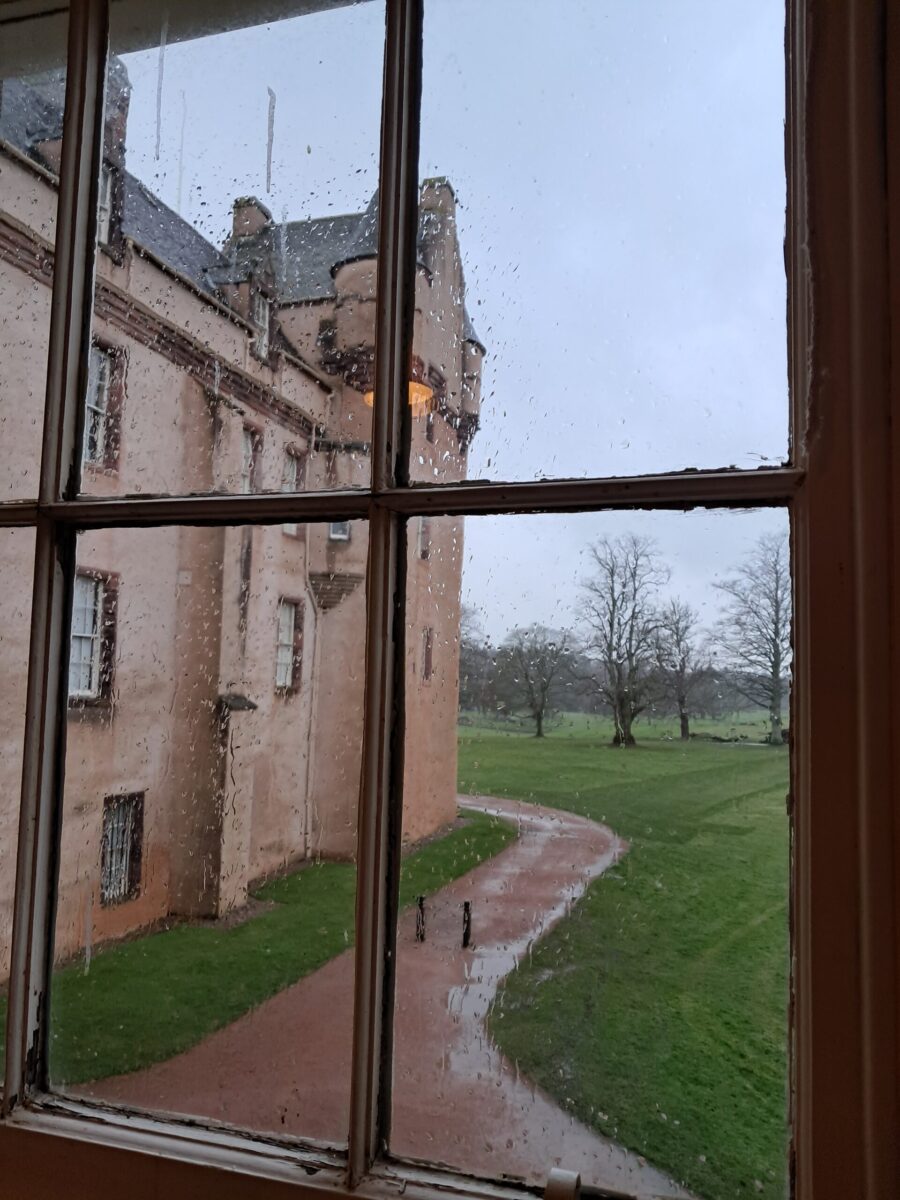
In textile conservation, you never know what interesting object you’ll be working on next! I recently travelled to Fyvie Castle to conserve a skittles alley bumper cushion for the National Trust for Scotland. Previously, I’ve worked on 1950s wrestling costumes, Egyptian grave goods, and Jacobite relics. However, a skittles alley cushion was a Rossi Conservation first!
History of the Object
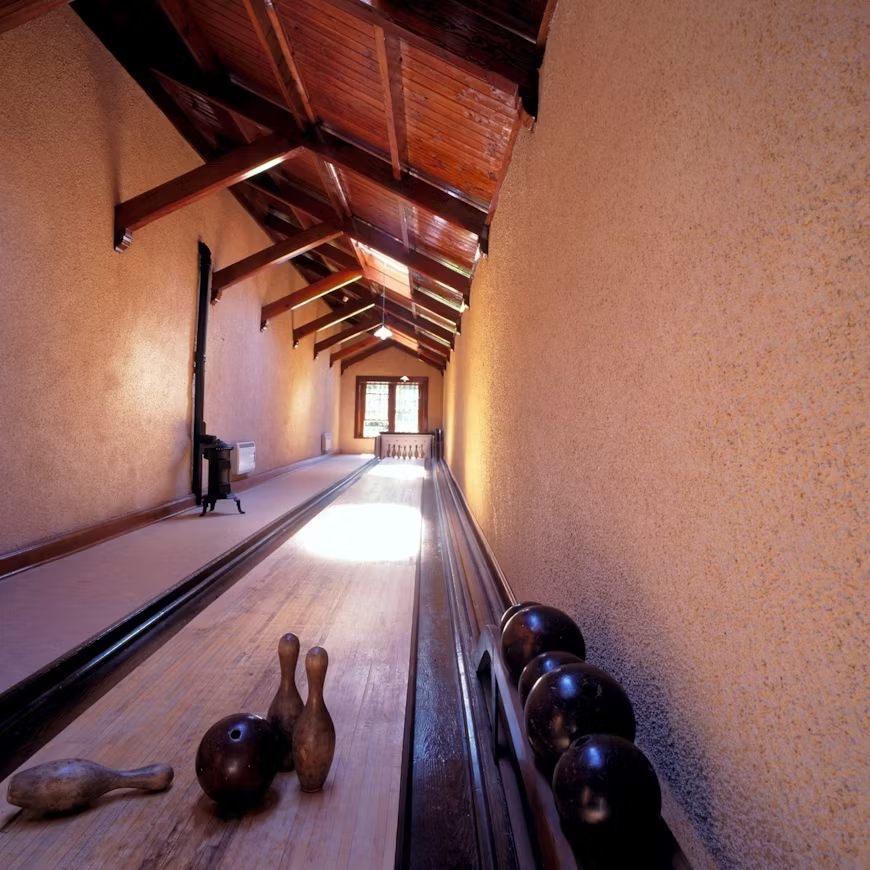
Like many historic homes, Fyvie Castle has been through several periods of change and ownership. Alexander Forbes-Leith was a Scottish born steel magnate who made his fortune in the United States. After returning to his homeland in 1889, Leith purchased Fyvie Castle and updated it with modern conveniences and American trends. This included the “Playhouse” which featured a Racquet court and Skittles Alley, the latter of which was imported from Chicago. Skittles is a precursor of modern nine-pin bowling, with numerous regional variations. The cushion I conserved sat at the end of the alley to stop the bowling balls.
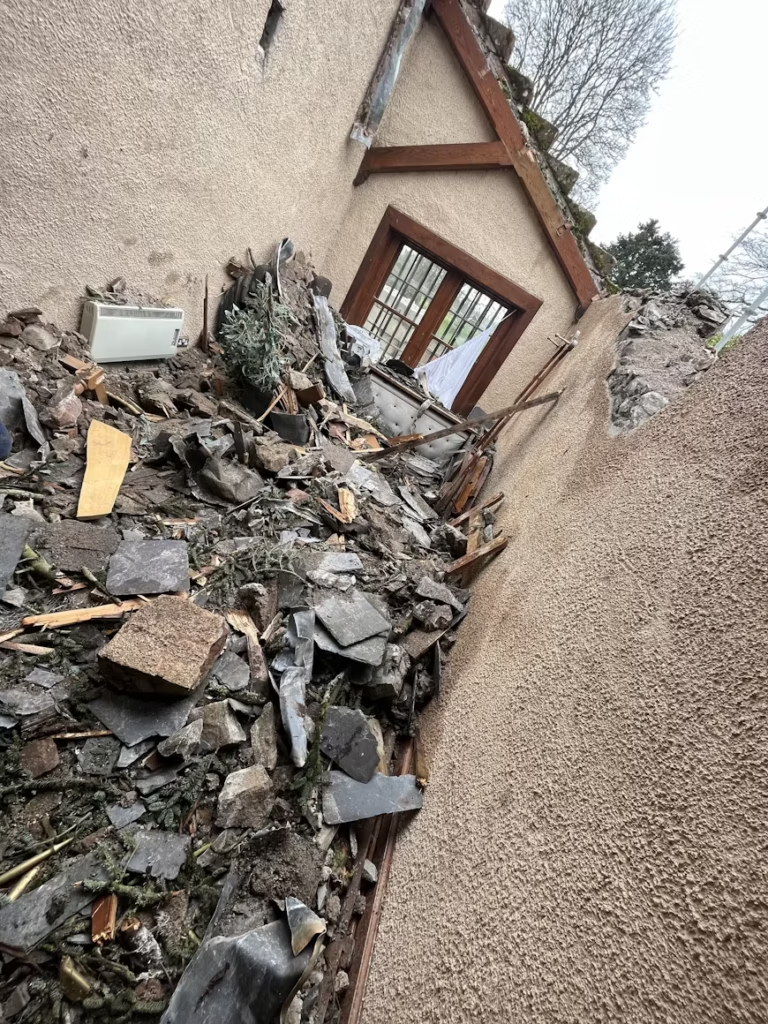
Unfortunately, if a conservator is brought in, something has often gone wrong. In spring 2023, during Storm Otto a noble fir tree fell onto the Racquets Court, collapsing part of the roof over the Skittles Alley. Rain water and debris stained and soiled the bumper cushion. In early 2026, I travelled to Fyvie Castle to clean the cushion so that it could be reinstalled in the repaired building, which is scheduled to reopen in Spring of 2026.
Conservation Treatment
After years of use and storm damage, the bumper cushion was quite dirty. There were multiple kinds of soil on the surface including scuff marks, small gray splatters, and brown staining from exposure to rain water. My job was to reduce this soiling to improve the cushion’s appearance, as well as ensure its long term preservation.

Before undertaking any remedial conservation, I assess what could go wrong with the treatment. My main concern with this conservation treatment was getting the object too wet. The cushion is stuffed with an unknown material, possibly animal hair. This material could have absorbed any water used during washing, making it difficult to dry, and leading to mould growth. To counteract this, I mostly used dry surface cleaning and damp swabs to carefully control the amount of water on the object.
Before and After Conservation
The conservation treatment was successful in reducing much of dirt on the bumper alley cushions. It was particularly effective at removing the gray speckled soiling and scuff marks on the surface. I hope I can visit Fyvie Castle again soon and see the cushion installed in the newly repaired Skittles Alley! If you have a historic textile in your care , you can learn more about the conservation treatments offered by Rossi Conservation here.


