

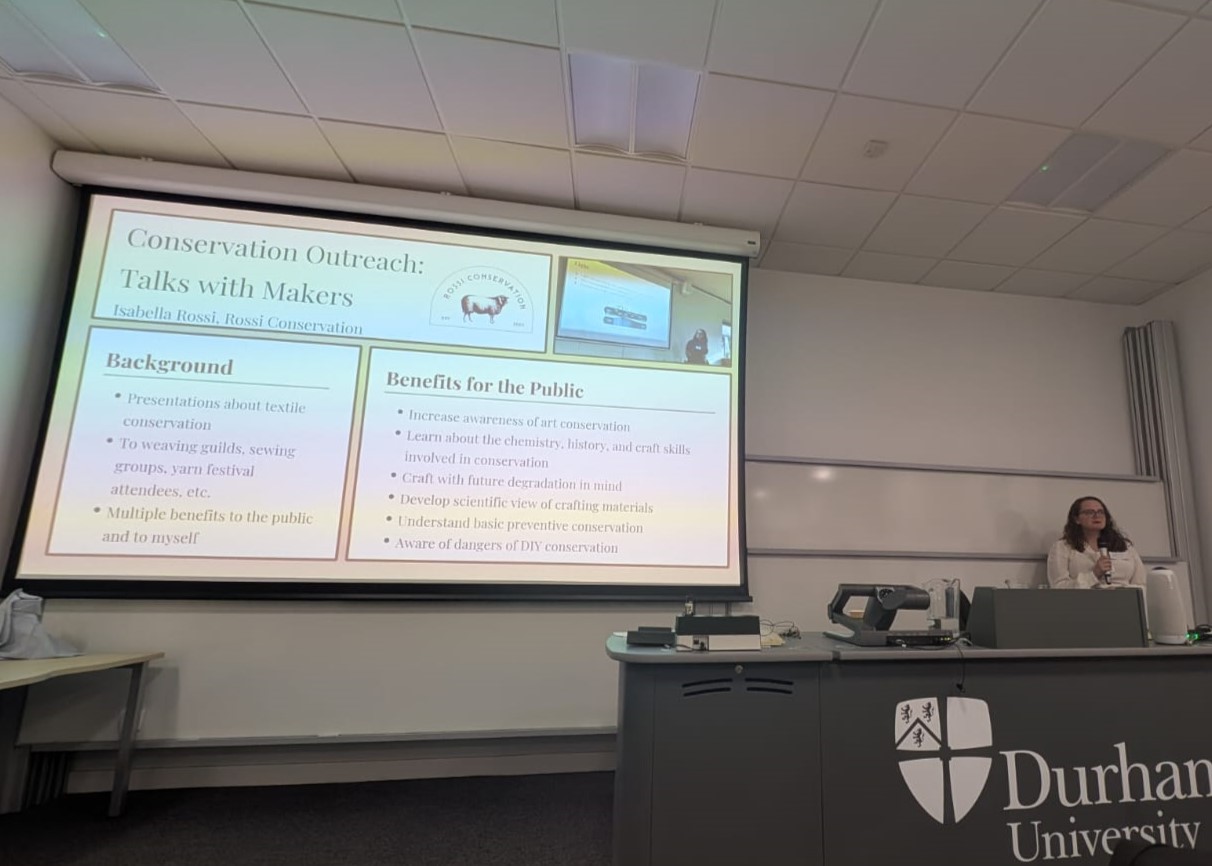
On 25th July 2025, I presented a poster at the Icon Emerging Professionals Group’s first conference in Durham. My poster was entitled “Conservation Outreach: Talks with Makers”, and was inspired by the numerous talks I have giving to crafting groups about my work as a textile conservator. From these talks, I have observed benefits to my audience and myself.
Benefits for the Public
The most obvious way that the public benefits from these talks is they come away with an increased awareness of art conservation. Art conservation is a relatively new field and has historically been behind-the-scenes, so many people are unfamiliar with it. The public also learns about the chemistry, history, and craft skills involved. Talking with makers is particularly rewarding. They develop a scientific understanding of the materials these use, and hopefully apply this knowledge to their future crafting! Also, my audience members learn about basic preventive conservation. This will help them preserve their work for the future. Additionally, they learn about the dangers of DIY conservation, and when they need to contact a professional like myself.

Benefits for Conservators
As a conservator, I have also benefited from these talks. They are an opportunity to hear other perspectives on my work, and connect with the people that my conservation efforts benefit. My talks are also an opportunity to reflect on conservation methods and ethics. Explaining your work to outsiders forces you to ask yourself why you made certain decisions. Additionally, for a conservator in private practice, discussing art conservation with non-conservators is a crucial skill. It is important to me that my clients understand how I propose to treat their objects, and these talks are a chance to practice explaining my work to people outside my field. These presentations are also a great excuse to refresh my knowledge on basic conservation principles, as well as promote my small business.

Outreach Tips
Art conservators are not known as the most gregarious people, but I have some tips on successful public outreach. It is important to tailor your talk to the knowledge and interests of your audience. I don’t need to explain what a warp is to a group of weavers! However, they would be interested in learning how a historic textile was woven.
Additionally, do not use overly technical or scientific language without explanation. Many people are not familiar with the term photo degradation, but can understand if you take the time to explain it to them. Also, ground concepts with examples that the audience is familiar with. When explaining photo degradation, I use the example of upholstered furniture by a window. If you flip over your sofa cushion, the once hidden fabric is a much brighter colour! It is also a good idea to include interesting case studies accompanied by images to emphasise your points. I also like to bring fabric swatches, tools, and needles that can be passed around, so audience members have a tactile understanding of my work.
When talking with the public, I believe it is better to give practical advice, rather than ideals. People are not going to keep their homes at the recommended relative humidity of 40-65%. However, they can be told not to store their heirlooms in their basements or attics. On the other hand, it is important to stand firm on what needs to be treated by a professional conservator. I discuss when you should contact a textile conservator in this post here. I also try to be reasonable on what an amateur can do. You don’t need a textile conservator to patch a quilt with no sentimental, historic, or financial value.
One of the most important things is to listen! I am always impressed by the knowledge, questions, reflections, and ideas that come from the public. It’s important to leave our conservation echo chamber and hear what other people have to say about our work.

Future Outreach Efforts
I am hoping to continue conservation outreach talks in the future! If you or an organisation you represent are interested in learning more about textile conservation, feel free to contact me here. I’ve also included a PDF of my poster below.